
Burgundy 2022: Quality Wines, Ample Supply, Balanced Prices
The 2022 Burgundy vintage has delivered exactly what winemakers and buyers were hoping for: high-quality wines with solid ratings and, thankfully, ample supply. After the extremely low yields of 2021, many producers had to raise prices just to stay afloat. Some couldn’t even release any wine, while most had to drastically reduce allocations due to the scarcity. So, when prices on these already premium wines soared as the market started to cool, it didn’t go down well with buyers.
For a lot of people, the 2021 Burgundy En Primeur campaign was a breaking point, underscoring just how unaffordable Burgundy had become, even at the village wine level. Yes, most of the wines sold out, but that was largely because of the low supply, not skyrocketing demand.
After more than a year of corrections and double-digit drops in fine wine indices, the Burgundy market was overdue for a win. The industry needed a decent harvest to replenish a critically low inventory—and it got just that, much to the relief of producers and merchants. They also needed high-quality wines to justify Burgundy’s higher price tags, and critics are saying that quality is definitely there, maybe even surpassing expectations. The final piece of the puzzle? Prices low enough to attract both seasoned and new buyers to clear out available stock.
It looks like Burgundy producers took note of market feedback and have kept price hikes to a minimum. Around 10% of producers even dropped their prices slightly, and about 40% raised theirs, but only modestly, making it easier to sell in some cases. Allocations have mostly been restored, and merchants are optimistic that the 2022 vintage will eventually sell, even if it’s slower than in past years.
Are buyers rushing to stock up on 2022 Burgundy? It’s still early to tell. Some merchants are only now launching their campaigns, and the response has been mixed. But one thing’s for sure—it’s going better than many anticipated at the end of last year.
2022 Burgundy: Strong Yields, High Quality, and Price Pressure
The 2022 Burgundy vintage, despite record-breaking temperatures and bouts of hail and flooding in some areas, brought much-needed relief for producers. This was the first year in a decade to reach average yields (40-45 hl/hectare) after several small harvests, with cool nights preserving acidity in the grapes, resulting in high-quality wines.
With costs rising for producers, especially those purchasing grapes and juice, price adjustments are inevitable. The Burgundy market faces pressure to align release prices with what buyers are willing to pay, particularly as scarcity—a major factor in driving demand—will not be an issue for the 2022 and 2023 vintages. As larger volumes of wine are available, some price adjustments may be necessary to ensure continued interest and sales in an increasingly competitive market.
Regional Trends in Burgundy Wine Trade
Analyzing Burgundy wine trade by region and classification reveals some interesting trends.
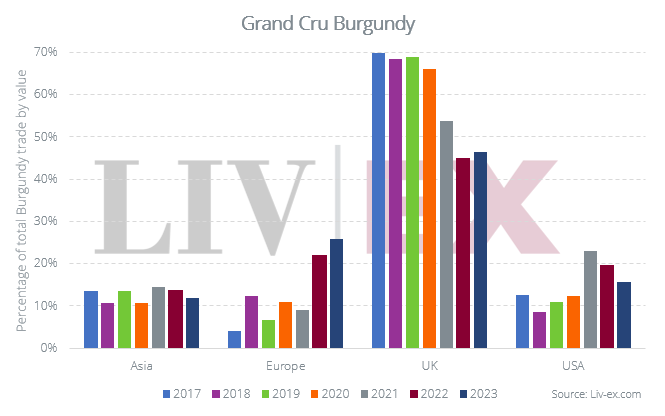
For instance, Asia’s share in Grand Cru Burgundy trade has held steady since 2017, while the UK’s share saw a notable drop in 2021, making room for Europe and the USA to claim a larger slice.
On the other hand, at the Village wine level, the UK increased its market share in 2023, largely at the expense of European and American buyers. Meanwhile, Asian interest in Village wines bounced back after a dip in 2022, nearly reaching 2021 levels, suggesting ongoing demand for Burgundy wines in Asia, albeit with a slight shift away from top-tier selections.
In contrast, the USA’s share of Burgundy trade saw another dip in 2023, despite U.S. buyers no longer being hindered by EU tariffs from the aircraft dispute and benefiting from a favorable currency position. This could be partly due to the growing popularity of domestic Pinot Noirs and Chardonnays in the U.S. market.
Oregon, though still a minor player in the secondary market, has expanded its presence significantly, increasing its trade share tenfold since 2018. California, too, is gaining ground, capturing 6.2% of secondary market trade in 2023.
A Shifting Distribution Model in Burgundy Wine
Burgundy’s wine distribution system is undergoing a shake-up, especially for high-demand Grand Cru and “cult” wines. Some companies are now bypassing traditional négociants and merchants to offer select wines directly to consumers. In a market where securing allocations can be tough and bottles are rare, this direct-to-consumer approach is an attractive option for many Burgundy enthusiasts.
Advocates say this new model could open the door for younger buyers who might not have established relationships with merchants, making it easier to access Burgundy’s coveted wines. By removing the middleman, the process becomes more accessible and less reliant on industry connections, potentially making Burgundy wine more inclusive. However, the addition of blockchain technology by some producers to verify wine authenticity could introduce a new layer of control over the secondary market, which may not sit well with all collectors. After all, not every buyer intends to consume every bottle; many view their purchases as investments.
On the flip side, critics argue that cutting out merchants could weaken the long-standing relationships that have supported Burgundy Domaines through all market conditions. Merchants don’t just sell wine; they build narratives around each vintage and cultivate loyalty among collectors, helping wine lovers follow growers’ journeys and appreciate the story behind each bottle. Removing merchants risks losing this valuable storytelling aspect, which is part of what adds prestige and value to Burgundy wines.
There’s also concern that selling directly to the highest bidder might actually make these wines even more exclusive, limiting access for a broader range of buyers and further reducing market liquidity. Burgundy has always been complex to navigate, and while new distribution channels might simplify access for some, they could reduce transparency and restrict trading freedom for others, impacting the market’s appeal. Less liquidity, coupled with decreased transparency, may eventually lead to a drop in prices, as limited trade can stifle demand.
FAQs
Why was the Burgundy 2022 campaign considered challenging?
Many feared Burgundy 2022 would struggle due to a mix of factors, including high yields and falling secondary market prices. The campaign faced resistance as some buyers turned down allocations and hesitated at rising prices.
What does the low bid-to-offer ratio mean for Burgundy wines?
The low bid-to-offer ratio indicates a cautious approach from buyers, suggesting that Burgundy prices may still need to adjust downward as the market corrects.
How did critics influence the Burgundy 2022 campaign?
Major critics’ positive reviews of Burgundy 2022 helped maintain interest in the wines, providing a “hangover cure” that encouraged buyers to keep purchasing, even in a challenging market.
What factors may affect the fine wine market in 2024?
Issues like global conflicts, a weak Chinese economy, sluggish growth in Europe, high interest rates, and reduced government spending may impact discretionary spending, potentially dampening demand in the fine wine market.
What is the future outlook for Burgundy prices?
With a large 2023 Burgundy crop on the way, prices are unlikely to rise further. There’s speculation that they may even need to decrease to sustain buyer interest.